Practise Role-Specific AI Mock Interviews
Build a mock interview around the role, job description and your own application materials. Respond by text, voice or code, then review specific feedback before your next attempt.
Last updated:
Knowing what you want to say is different from delivering it clearly under pressure. With Lyrra, you can build a mock interview around a specific role, job description, and your own application materials, then rehearse in the format that best matches your next hiring round.
Build the session around the role
During setup, choose a specialisation, experience level, interview type, language, and duration. You can also add the job description and select a saved resume or cover letter. This gives the questions a real preparation target instead of relying only on a generic question bank.
You control which documents are attached. Before starting, check that they are current and do not contain information you would rather keep outside the practice session.
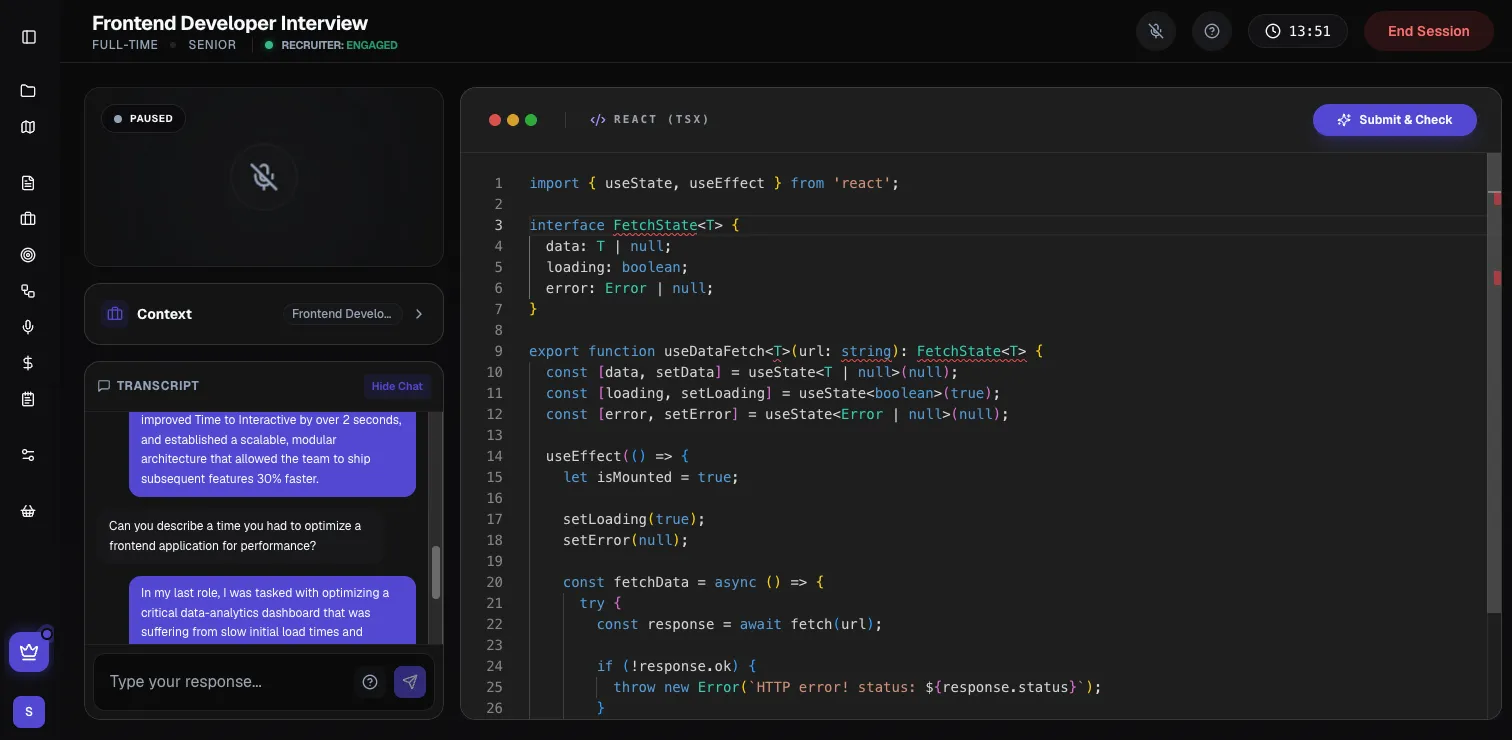
Role, experience level, and job-description context shape the practice questions.
Choose the interview format you need
Mode | Best for | Main feedback |
|---|---|---|
Behavioural | Past experience and competency questions | STAR structure, specificity, and individual contribution |
Technical | Role-specific knowledge and reasoning | Assumptions, technical depth, and trade-offs |
Coding | A structured challenge in the code editor | Available tests, edge cases, solution quality, and explanation |
Stress Test | More demanding follow-up questions | Clarity and response under simulated pressure |
Depending on the mode, you can respond through text, voice, or code. Stress Test is an optional higher-pressure rehearsal mode; it is not a psychological assessment of resilience.
Practise responding, not reciting
The session asks you to retrieve and shape an answer in real time. Voice practice can help you review pace, length, and clarity. In a coding challenge, you can run available tests, inspect errors, and explain your reasoning. The aim is not to memorise a polished script. It is to build a structure you can deliver naturally in your own words.
Review individual answers, not only a score
After the session, the report organises strengths, improvement areas, and suggested next steps. A behavioural answer may be missing part of the STAR structure. A voice response may need a clearer pace or fewer filler words. A coding submission may need stronger edge-case handling or a clearer explanation of its trade-offs.
Fictional example: “I helped the team deliver the project” gives an interviewer little evidence to assess. The review might ask for the problem, your decision, and the result. A stronger version does not need to be much longer: “When two stakeholders had conflicting priorities, I mapped the dependencies, agreed the order with the product owner, and kept the release on schedule without dropping testing.”
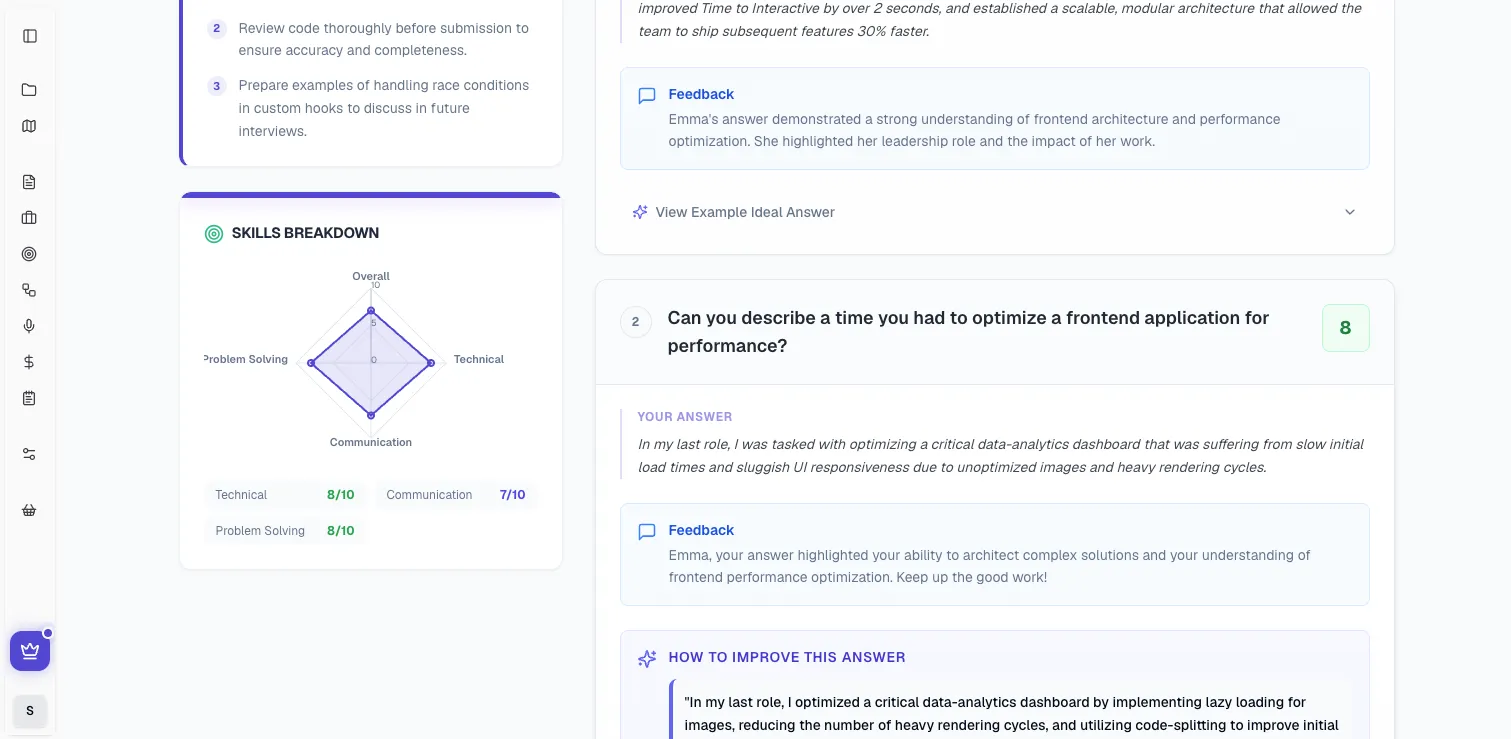
The report helps you identify which moments are worth another attempt.
Track comparable progress across sessions
Your session history lets you revisit earlier responses and see whether the same skill improves in later attempts. A technical interview score should not be compared directly with a behavioural interview score. The most useful comparisons keep the format, difficulty, and skill focus reasonably similar.
Understand what AI feedback can tell you
The report is an AI-generated interpretation of a practice session. It is not a hiring decision, and cannot predict how a real employer will respond. The response timeline shows how the simulated interviewer evaluated each exchange. Use it to find moments worth reviewing, not as a measure of your chance of receiving an offer.
Companies use different interview rubrics and expectations. For a high-stakes process, repeated practice can be complemented by feedback from someone you trust, a mentor, or a specialist who understands the role and industry.
Start with one focused session
Choose the format closest to your next interview, attach only the context that matters, and improve one or two points after the session. That focused loop is more useful than opening many unrelated simulations without a clear goal.
Start a role-specific mock interview
If you want to organise the wider preparation first, use the complete job interview preparation guide.